Astronomy and interpretation are different
Astronomy describes physical objects and their motion. Astrology assigns symbolic meanings to chart factors. Calculating a planet's position does not prove the interpretation attached to it. This overview describes common modern Western associations, not measured effects on your life.
Sun and Moon
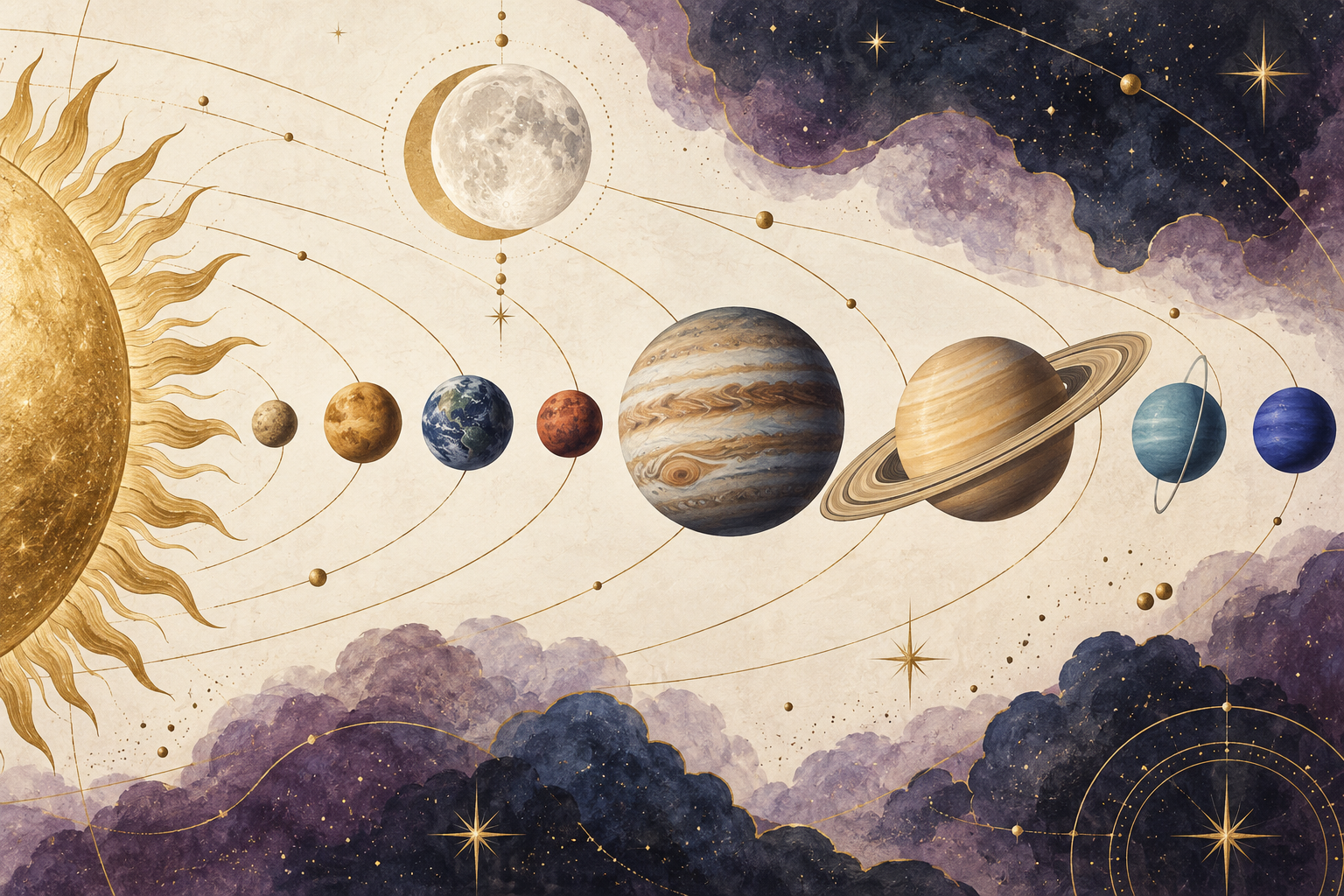
Astrologers often discuss the Sun and Moon alongside planets, although the Sun is a star and the Moon is Earth's natural satellite. In common Western symbolism, the Sun relates to self-expression and the Moon to emotional experience.
Mercury, Venus and Mars
Mercury is commonly associated with communication, Venus with affection and values, and Mars with action. These are starting terms for understanding astrology writing. One placement cannot establish another person's feelings, your relationship prospects or a future event.
Jupiter and Saturn
Jupiter is often connected with expansion and Saturn with limits or responsibility. A reflective reading might explore the balance between exploring possibilities and setting boundaries. Neither planet guarantees success or failure.
Outer planets and different traditions
Many modern Western astrologers also use Uranus, Neptune and Pluto. Different schools assign them different roles. Do not assume that a Western explanation translates directly into a Vedic interpretation; the chart method and tradition should be stated.
Ask what supports a claim
When a reading mentions a planet, ask whether its position was actually calculated, which interpretive method was used and what remains uncertain. Treat unsupported predictions as unsupported, even when the terminology sounds technical.
Sources and further reading
Astronomy sources explain physical motion; astrology sources describe traditions, not proof of predictions.
This guide offers general educational context. Personal interpretation requires accurate birth details and the complete chart.
Explore your birth chart